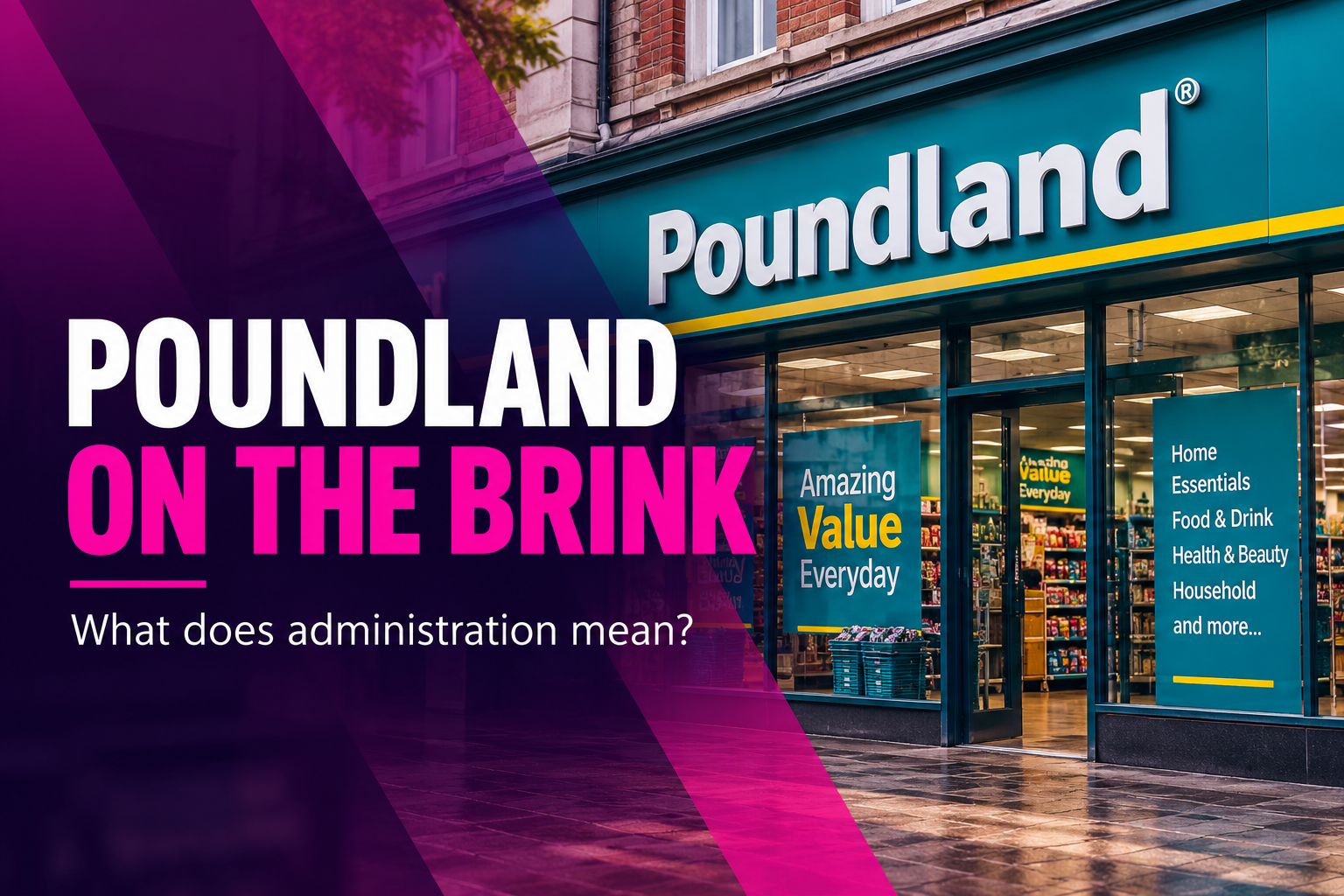
Poundland files notice of intention to appoint administrators: what happens next?
Poundland has filed a notice of intention to appoint administrators as efforts continue to secure a rescue deal for the discount retailer. Around 12,000 jobs and approximately 600 stores are affected by the uncertainty.
DCA Business Recovery | 29 October 2026 | 5-minute read
Approximately 12,000 jobs reported to be at risk
Approximately 600 stores across the UK and Ireland
Working-day breathing space following the filing
Nominal price paid by Gordon Brothers for Poundland in 2025
What has happened at Poundland?
Court filings reported on 29 October 2026 show that Poundland has filed a notice of intention to appoint administrators.
The filing gives the retailer a short period of protection from certain creditor action while efforts continue to secure a rescue or sale of all or part of the business.
Important context: Poundland has filed a notice of intention to appoint administrators. That is not the same as administrators already having been appointed. At the time of writing, the business remains in the period before a formal administration appointment.
Poundland currently operates around 600 stores, while reports indicate that approximately 12,000 jobs could be affected if a rescue cannot be achieved.
Why is Poundland in financial difficulty?
Poundland has been undergoing a significant restructuring since Gordon Brothers acquired the retailer from Pepco in 2025 for a nominal £1.
The business has already closed more than 100 stores as part of attempts to reduce costs and reshape its store estate.
Stores have already closed
Poundland has been trying to reduce its cost base and improve performance, including the closure of more than 100 stores during its turnaround programme.
Buyers remain interested
A number of retailers and investors have reportedly expressed interest in acquiring Poundland stores or other parts of the business.
The latest crisis follows the rejection of a proposed takeover by Martin Property Group, which Poundland management had reportedly supported as a potential solvent rescue of the business.
What is a notice of intention to appoint administrators?
A notice of intention to appoint administrators is a formal step which can provide a company with a temporary moratorium while its directors and advisers consider whether administration or another rescue can be achieved.
| Stage | What it means |
|---|---|
| Notice of intention | A formal filing is made indicating an intention to appoint administrators. This can create temporary protection from certain creditor action. |
| Rescue discussions | The company and its advisers can continue discussions with potential purchasers and other interested parties. |
| Administrator appointed | If an appointment takes place, licensed insolvency practitioners take control of the company’s affairs. |
| Rescue or sale | The administrator may seek to rescue the company or sell the whole business or individual parts of it. |
The filing reportedly gives Poundland 10 working days of breathing space while efforts continue to secure a deal.
What could happen next?
There are several possible outcomes. Filing the notice does not automatically mean that every Poundland store will close.
A rescue deal
A buyer could acquire Poundland as a whole, allowing a substantial part of the business to continue trading.
Stores sold separately
Retailers or investors could acquire packages of stores, potentially preserving some locations and jobs.
Formal administration
If a rescue is not completed beforehand, administrators may be formally appointed to take control of the business.
Reports indicate that parties interested in parts of the Poundland estate include businesses connected with Poundstretcher, The Range and other retailers.
What would administration mean for Poundland?
If administrators are formally appointed, their role would be to pursue the statutory purpose of the administration and achieve the best available outcome in the circumstances.
Trading could continue
Administration does not automatically mean that a business stops trading. Stores may remain open while the administrators assess offers and pursue a sale.
Some stores may not survive
If individual locations are not commercially viable or cannot be sold, store closures and redundancies may follow.
An administrator can also sell individual assets or parts of the business where rescuing the existing company as a whole is not achievable.
What does this mean for Poundland employees?
The uncertainty is understandably significant for Poundland employees, but a notice of intention does not mean that every employee has immediately been made redundant.
- Stores may continue trading. A business can continue operating while rescue discussions take place or during an administration.
- A purchaser may acquire stores. Where a business or part of a business is sold, employment may potentially transfer depending on the circumstances.
- Some redundancies may still occur. Stores which cannot be rescued or sold may ultimately close.
- Employee claims may arise in an insolvency. Where an employer becomes formally insolvent, eligible employees may be able to claim certain statutory amounts through the Redundancy Payments Service.
What does this mean for suppliers and other creditors?
Suppliers, landlords and other creditors will be watching the situation closely.
Recent reporting has suggested that some suppliers were becoming concerned about payments and deliveries as Poundland’s financial position deteriorated.
If administrators are appointed: creditors would normally receive formal information from the administrators explaining the appointment, the financial position and how they propose to deal with the company’s affairs.
The amount ultimately recovered by unsecured creditors would depend on the value of the business and assets, the outcome of any sale process and the ranking of claims.
What can smaller company directors learn from the Poundland situation?
Poundland is a major national retailer, but the basic principles are relevant to businesses of every size.
Know the true position
Keep cash-flow forecasts, creditor balances, HMRC liabilities and upcoming payments under regular review.
Decide whether recovery is realistic
Further borrowing is not always the answer if the underlying business is continuing to lose money.
Take advice early
Waiting until a creditor presents a winding-up petition can significantly reduce the options available to directors.
Administration is not appropriate for every insolvent company. For smaller owner-managed businesses which cannot realistically recover, a Creditors’ Voluntary Liquidation (CVL) may instead be an appropriate way of bringing the company’s affairs to an orderly conclusion.
Frequently asked questions
Has Poundland already gone into administration?
No. As at 29 October 2026, Poundland has filed a notice of intention to appoint administrators. This is a formal step towards possible administration, but it is not the same as administrators already having been appointed.
Are all Poundland stores going to close?
Not necessarily. Potential buyers are reportedly interested in Poundland and parts of its store estate. Some stores could continue trading even if others ultimately close.
How long does Poundland have to find a rescue?
The notice is reported to provide around 10 working days of breathing space from creditors while rescue discussions continue.
Can a company continue trading in administration?
Yes. Administrators can continue trading a company or its business where doing so is considered appropriate, including while they seek a buyer.
Does every insolvent company need administration?
No. The appropriate procedure depends on the circumstances. Smaller insolvent companies may instead consider options such as restructuring, a Company Voluntary Arrangement or a Creditors’ Voluntary Liquidation.
Worried about your company’s finances? Speak to DCA.
If your company is struggling with cash flow, HMRC arrears, supplier pressure or creditor action, we can talk through the position and explain the available options clearly. DCA Business Recovery is a family-run insolvency practice offering confidential, no-pressure initial advice.
Sources and further reading
This article is general information for UK businesses, correct at 29 October 2026, and is not specific legal or insolvency advice. Poundland’s position is developing and may change after publication. Insolvency options depend on the circumstances of the individual company.