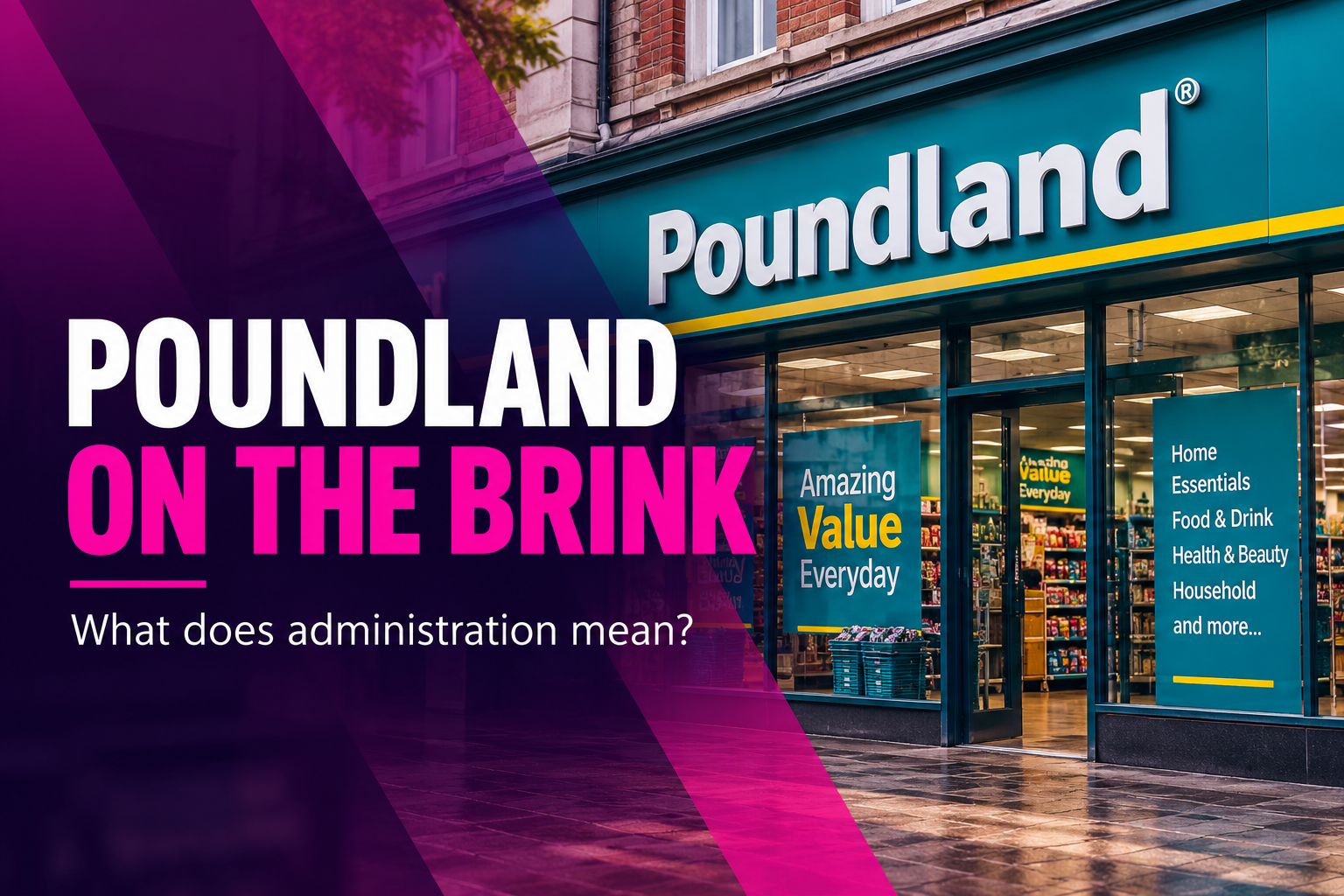
Poundland rescue talks reach critical stage as administration fears grow
Reports suggest the future of one of Britain’s biggest discount retailers is increasingly uncertain, as disagreements emerge over its proposed rescue and the possibility of an insolvency process.
Poundland is facing a critical period in its efforts to secure a future for the business. According to Sky News reporting on 27 October 2026, three recently recruited directors are considering resigning amid a disagreement with majority owner Gordon Brothers over a potential sale.
At the centre of the dispute is a reported solvent offer from Martin Property Group. Other interested parties have considered acquiring parts of the retailer’s store estate. The competing approaches raise a question familiar to insolvency professionals: can a business be rescued intact, or is a sale of selected operations and assets more likely?
What has happened at Poundland?
Gordon Brothers took control of Poundland in 2025. As talks about a sale progressed, three independent directors were brought onto the board in October 2026. Sky News now reports that those directors may leave following disagreement over the route being pursued.
Martin Property Group has been reported as proposing a solvent acquisition, while interest from other retailers and investors has included proposals focused on parts of Poundland’s estate. Earlier reporting suggested that the owner of Poundstretcher had shifted from a whole-company proposal to an interest in fewer than half of Poundland’s UK shops.
These are reported proposals and discussions; they are not completed transactions. The independent directors’ appointments can also be checked on Companies House, although a filing of a directorship does not establish that an insolvency appointment has occurred.
What are the possible outcomes?
1. A solvent rescue or sale
A buyer may acquire the company as a going concern, with an agreed plan to fund and restructure its operations. The viability of any offer depends on finance, creditor terms and the company’s actual financial position.
2. Administration and business sale
An administrator may seek to rescue the company or achieve a better result for creditors than an immediate liquidation. Depending on circumstances, a business or asset sale may take place, including a pre-pack sale.
3. Sale of selected stores or assets
Potential purchasers might be interested in only part of the operation. That does not automatically mean every remaining store must close, but it can leave significant uncertainty for employees, suppliers and landlords.
4. Further restructuring or closure
If funding or a viable rescue cannot be agreed, further restructuring or closures may be considered. The appropriate legal process would depend on the entities and their financial circumstances.
What does administration mean for employees?
Administration does not automatically make every employee redundant. The position will depend on whether a business continues trading, whether jobs are transferred with a sale, and whether redundancies become necessary.
If employees are made redundant and their employer is insolvent, qualifying individuals may be able to claim certain statutory entitlements through the government Redundancy Payments Service, subject to eligibility and statutory limits. A transfer of a business may also raise TUPE considerations, which require specialist advice.
Retail trade union Usdaw expressed concern on 12 October about the prospect of administration and the potential effect on its members. At publication, job losses on the scale suggested in some headlines remained a risk, not a confirmed outcome.
What can directors of smaller businesses learn?
Although Poundland operates on a very different scale from most owner-managed companies, the underlying challenges are recognisable: cash flow uncertainty, creditor pressure, difficult funding decisions and the need to consider options before time runs out.
Five practical points for company directors
- Seek advice early. There may be more options while a company still has cash and time to negotiate.
- Keep accurate forecasts. Test whether proposed funding or a rescue offer is genuinely deliverable.
- Understand directors’ duties. As insolvency becomes probable or unavoidable, directors must properly consider creditors’ interests in accordance with applicable law.
- Protect records and assets. Document board decisions and take advice before transferring assets or making unusual payments.
- Consider the right procedure. Administration, a CVA, informal restructuring and a creditors’ voluntary liquidation (CVL) serve different purposes; not every struggling company needs liquidation.
For many smaller companies, a confidential review with DCA Business Recovery can clarify whether recovery is realistic and, if not, which formal or informal steps may be appropriate.
Frequently asked questions
Has Poundland entered administration?
Not on the basis of the information verified for this article on 27 October 2026. Reports say administration is a possibility, but a formal appointment has not been established here.
Does administration always mean a company closes?
No. Administration can provide a route to rescue the company or sell its business and assets. The result varies from case to case.
Can a director sell company assets before liquidation?
Potentially, but directors should obtain independent professional advice, ensure proper valuations and consider duties to creditors. Transactions may subsequently be investigated, including whether they were at an undervalue or preferential.
Is CVL the same as administration?
No. A creditors’ voluntary liquidation generally involves winding up an insolvent company and realising its assets. Administration has different statutory objectives and may involve continuing or selling a business.
Worried about your company’s future?
If your company is struggling with cash flow, creditor pressure or uncertainty about continuing to trade, DCA Business Recovery can help you understand the available options in plain English. We will also tell you when liquidation may not be necessary.
Dedicated, Caring and Approachable. Family-run insolvency advice, with real people available on our Directors’ Helpline seven days a week, 8am–8pm.
Sources and publication note
- Sky News: Poundland close to collapse as new directors head for exit (27 October 2026)
- Sky News: Poundstretcher owner withdraws rescue bid for rival Poundland (13 October 2026)
- Usdaw: Poundland concerns (12 October 2026)
- Companies House: Poundland Limited filing history
Prepared 27 October 2026. News information can change rapidly. This is general information rather than advice on any particular company’s circumstances.