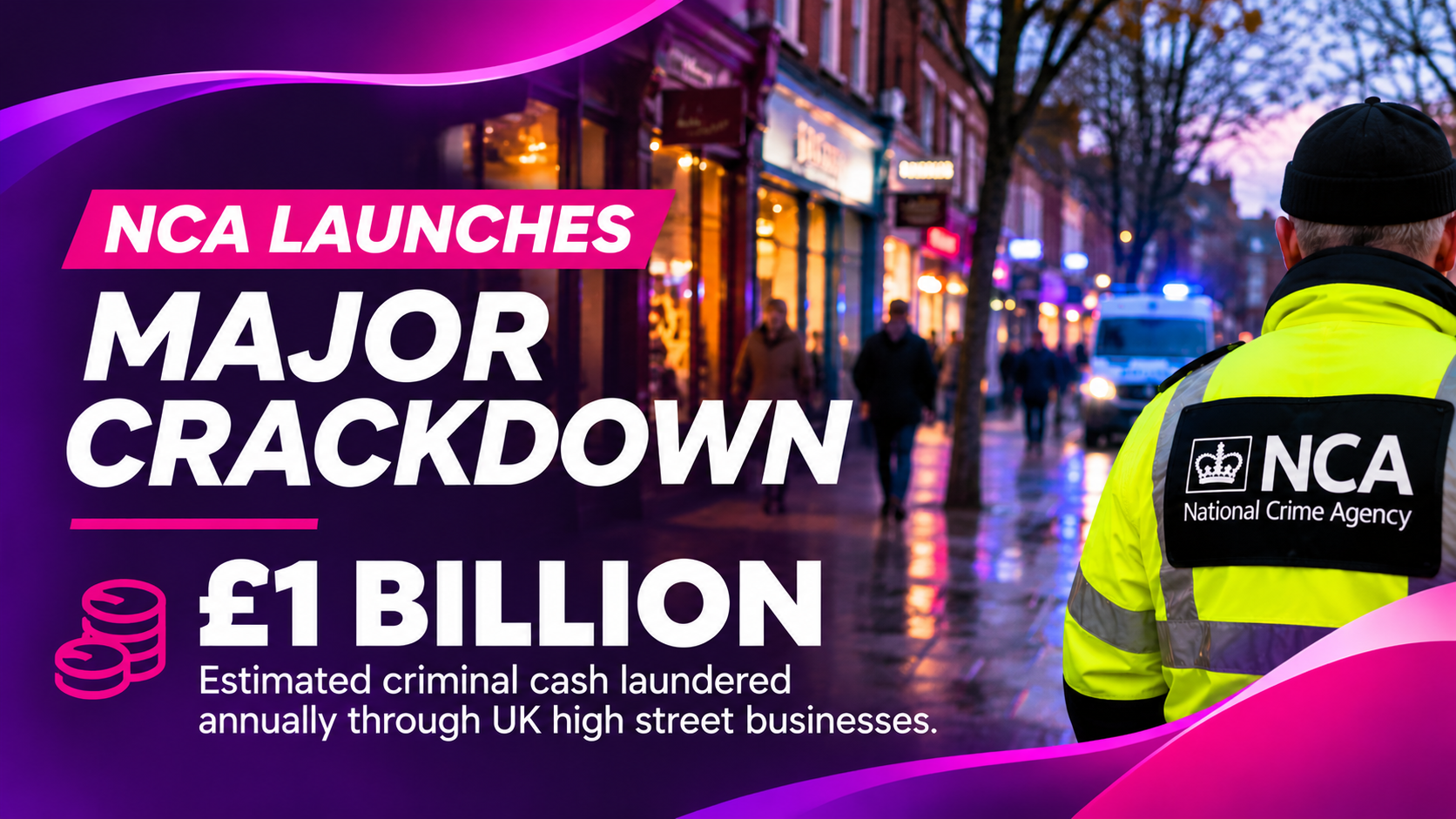
The National Crime Agency (NCA) has announced the results of a major nationwide operation targeting money laundering and organised criminal activity involving UK high street businesses.
Operation Machinize, coordinated by the NCA and the National Police Chiefs’ Council, brought together police forces, government agencies and regulatory bodies throughout October 2026.
The findings, published on 11 November 2026, highlight the scale of financial crime affecting legitimate businesses, local communities and the wider economy.
What Happened During Operation Machinize?
The operation focused on identifying businesses suspected of being used to launder criminal proceeds or facilitate other unlawful activities.
According to the NCA, the October operation resulted in significant enforcement activity across the United Kingdom.
3,029 premises visited or raided across the UK.
349 arrests made during coordinated enforcement activity.
£2.2 million in cash seized.
£3.7 million in account freezing orders obtained.
£4.2 million in duty and tax evasion identified or prevented.
£6.8 million in criminal commodity seizures, including illegal drugs and tobacco products.
These figures demonstrate the scale of the coordinated enforcement activity and the importance being placed on tackling the criminal exploitation of legitimate businesses.
At Least £1 Billion Laundered Annually
The National Crime Agency estimates that at least £1 billion of criminal cash is laundered through cash-intensive high street businesses in the UK each year.
The agency has identified sectors including barber shops and vape shops as areas where some businesses have been exploited by organised criminals.
This does not mean that businesses operating in these sectors are generally involved in criminal activity. The concern is the misuse of otherwise legitimate business structures by organised criminal networks.
Which Authorities Were Involved?
Operation Machinize involved several major enforcement and regulatory organisations working together to identify suspected criminal activity.
National Crime Agency
Coordinating intelligence and enforcement activity against organised criminal networks, money laundering and illicit financial activity.
HM Revenue & Customs
Supporting investigations into tax evasion, undeclared income and other financial irregularities involving businesses.
Companies House
Participating in the coordinated operation alongside other authorities, reflecting the importance of company information, ownership and corporate transparency.
The Insolvency Service
Taking part in the wider enforcement operation, highlighting the relevance of corporate conduct and the potential misuse of limited companies.
Police forces, Regional Organised Crime Units, Trading Standards, Immigration Enforcement and other agencies also participated.
Why Does This Matter in Insolvency?
When a company enters liquidation, the appointed insolvency practitioner has responsibilities extending beyond simply closing the business.
Depending on the circumstances, the liquidator may need to examine company records, investigate transactions and consider the conduct of those responsible for managing the company.
Insolvency investigations may identify a number of matters requiring further enquiries.
✓ Unexplained payments to directors or connected parties.
✓ Significant cash withdrawals without adequate supporting records.
✓ Transactions inconsistent with the company’s recorded trading activities.
✓ Unusual transfers between connected companies.
✓ Incomplete accounting records or unexplained differences between reported income and banking activity.
✓ Potential misuse of company funds or assets.
Such matters do not automatically establish wrongdoing. However, they may require further enquiries, supporting documentation and consideration of any relevant reporting obligations.
What Does This Mean for Company Directors?
Company directors are responsible for maintaining adequate accounting records and ensuring that company transactions can be properly explained.
Where a company subsequently becomes insolvent, its financial affairs may be examined as part of the liquidation process.
Directors should therefore be able to explain significant transactions and provide appropriate supporting evidence.
A Practical Reminder
Poor record-keeping does not necessarily mean that fraud or money laundering has occurred.
Nevertheless, missing records, unexplained payments and incomplete transaction histories can make it considerably harder to establish what happened to company funds.
Directors experiencing financial difficulties should seek professional advice early and preserve relevant accounting information.
Financial Warning Signs Worth Investigating
For insolvency practitioners, accountants and other professional advisers, unusual financial activity should be considered in context.
| Potential Warning Sign | Why Further Enquiries May Be Needed |
|---|---|
| Unexplained cash deposits | The source of funds may need to be established and reconciled with trading records. |
| Payments to connected parties | The purpose, commercial basis and supporting documentation may require review. |
| Missing accounting records | The absence of records may prevent transactions from being properly verified. |
| Unusual banking activity | Transactions inconsistent with known business activities may warrant further explanation. |
| Unclear beneficial ownership | Further enquiries may be needed to understand who ultimately owns or controls the business. |
None of these indicators is proof of criminal conduct in isolation. A proportionate, evidence-based assessment is essential.
Money Laundering Reporting Obligations
Insolvency practitioners and other regulated professionals have obligations under the UK’s anti-money laundering framework.
Where relevant information gives rise to knowledge or suspicion of money laundering, the applicable reporting requirements must be considered.
Depending on the circumstances, this may involve reporting concerns internally to the firm’s Money Laundering Reporting Officer (MLRO) and considering whether a Suspicious Activity Report should be submitted to the National Crime Agency.
Professionals must also consider confidentiality and the legal restrictions surrounding inappropriate disclosure or tipping off.
Operation Machinize does not introduce new reporting obligations for insolvency practitioners. Instead, it reinforces the importance of existing anti-money laundering controls, professional scepticism and properly documented investigations.
Is Operation Machinize Continuing?
Yes. The NCA has confirmed that Operation Machinize is developing beyond individual periods of coordinated enforcement.
The agency has described an ongoing approach intended to identify not only suspicious business premises but also the individuals and criminal networks benefiting from unlawful activity.
Across the operation’s various phases, more than 6,000 high street businesses suspected of criminal involvement have been raided.
The NCA has also established an ongoing intelligence coordination capability to support future investigations.
Why Transparency Matters
At DCA Business Recovery, we believe that proper financial records, transparency and early professional advice are essential when a company experiences financial difficulties.
The overwhelming majority of business owners facing insolvency are not involved in criminal activity. Many are dealing with genuine commercial pressures, including reduced turnover, rising costs and increasing creditor demands.
Nevertheless, insolvency practitioners have an important role in examining company affairs and ensuring that matters requiring further investigation are appropriately considered.
Our approach is to consider each company’s circumstances carefully, explain the process in plain English and help directors understand their responsibilities.
Frequently Asked Questions
What is Operation Machinize?
Operation Machinize is an NCA-coordinated initiative targeting organised criminal activity and money laundering involving UK high street businesses.
Can an insolvency practitioner investigate suspicious transactions?
Yes. Insolvency practitioners have statutory and professional responsibilities relating to the investigation of company affairs and director conduct. The nature and extent of enquiries depend on the circumstances.
Does liquidation mean directors are suspected of wrongdoing?
No. Companies enter liquidation for many legitimate commercial reasons. Insolvency does not, by itself, establish misconduct, fraud or money laundering.
What happens if suspicious transactions are discovered?
The circumstances should be assessed and appropriate enquiries undertaken. Depending on the information available, professional, statutory or anti-money laundering reporting obligations may arise.
Can a director be personally liable for company transactions?
Potentially. Certain transactions, breaches of duty or other misconduct may give rise to claims or enforcement action. However, personal liability does not arise simply because a company becomes insolvent.
Should directors seek advice before liquidation?
Yes. Early professional advice can help directors understand the company’s financial position, available options and their responsibilities before making important decisions.
Worried About Your Company’s Future?
We’re an independent, family-run insolvency practice. We’ll help you understand your options, without pressure or unnecessary jargon.
|
Start Your Free Advice Journey → |
Prefer to talk?
01702 344558
✓ Free advice
✓ No obligation
✓ Family-run
Sources & Further Reading
National Crime Agency — Operation Machinize: NCA-coordinated crackdown across the UK as work to reclaim the high street gathers pace. Published 11 November 2026.
Read the official NCA announcement →
UK Government — Reporting suspicious activity and money laundering concerns.
Important information: This article provides general information about Operation Machinize, financial crime and insolvency-related responsibilities. It does not constitute legal advice. Individual circumstances should always be considered with appropriate professional guidance. Information is based on the National Crime Agency announcement published on 11 November 2026.